
What equipment might you use?
Profiling bed
For some people, as their needs change, a profiling bed may be required.
This is the kind of bed you may be familiar with from hospital. It lifts up and down
and has different sections which can lift the head or foot of the bed.
A profiling bed may be used to help you maintain some independence with your
bed transfers, to help you get more comfortable in bed or to help your healthcare
team in providing safer care on the bed.

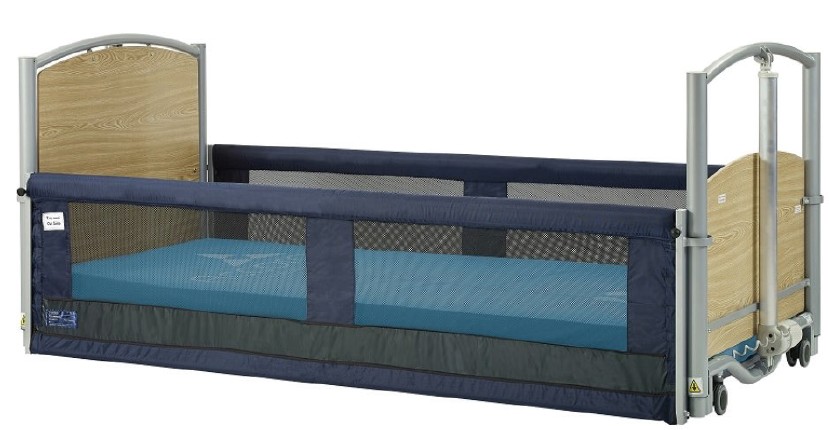
Bed rails
These are rails that attach to the side of profiling beds to reduce the risk of
a patient rolling, slipping or falling out of bed. For people who are at risk of this due
to drowsiness, physical changes, or their positioning in bed, bed rails can be helpful
to prevent injuries that may be associated with these falls. Bed rails should not be
used for people to pull on to help them move themselves in bed. They should also not
be used to limit a person’s ability to choose to get out of bed.
Grab handles
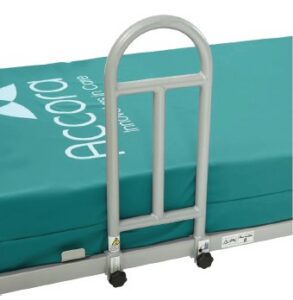
These are handles that attach either to the side of a profiling bed, or can be attached to some standard beds, that are used to help people move themselves in bed.
They are not used to help keep someone in bed.
These pieces of equipment can be really helpful in keeping you safe, while also allowing you to maintain as much independent function as possible and reducing the need to rely on others for your care.
What are the risks associated with these pieces of equipment?
There is a risk of entrapment with bed rails and grab handles.
Some illnesses can make people confused, or do things they wouldn’t usually do. People
can try and climb up and over, or through rails. Other illnesses can cause the body to
move in a way that isn’t predictable, leading to people getting tangled up in the rails
or handles. Injuries caused by this can be worse than any injury caused by a fall from a
bed without rails. There are reports of injuries such as broken limbs, entrapments of the
head, neck or chest, suffocation and death.
What is done to reduce the risks?
All equipment provided by Farleigh Hospice meets the requirements set out by
the Medicines and Healthcare products Regulatory Agency (MHRA). For example,
we only provide either mesh bed rails or those with bumpers on to reduce the
risk of entrapment. A thorough risk assessment is carried out to determine the
appropriateness of the provision of the equipment for each individual.
However, as people’s condition changes, equipment that was once suitable may no
longer be, so equipment is reassessed on a regular basis and may need to be removed
if it is no longer safe to use.
Who decides if bedrails and grab handles should be used?
If a person is able to make a decision themselves, a discussion between the healthcare
professional and that person about the risks and benefits of the rails or grab handles
should be had and a joint decision can be made. If the person is not able to make this
decision and there is no lasting power of attorney for health, the healthcare team will
make it on their behalf using the principles of the Mental Capacity Act (2005).
In making a decision the healthcare team will look at factors such as the person’s
cognition, any history of attempts to get out of bed, their current mobility, any
involuntary movements the person has, levels of drowsiness, as well as how and
when the equipment is going to be used. Grab handles and bed rails are often not
appropriate for people with significant cognitive impairment.
If bed rails or grab handles are not appropriate, the healthcare team will look at
alternative equipment to reduce the risk of falls and support with bed transfers, such as
crash mats on the floor around the bed, or a low rise bed which can be lowered down
so that any fall out of bed is from a very low height and reduces the risk of injury.
We will also consider other factors which may be contributing to falls and address
these if possible.
Bed accessories
Depending on your needs, other equipment may be delivered alongside your profiling
bed. These are assessed on an individual basis and if they have been provided they
should be used as prescribed. Please do not adjust any of this equipment yourself,
if you are concerned about the function of the equipment please contact your
healthcare professional or the equipment service who provided it. Examples of
this equipment may include:
Anti-entrapment kits
This is usually used for people who are of a lower weight who are at risk of injury from
getting limbs caught in the mechanisms of the bed – they include a bumper on each
end of the bed and a sleeve that encompasses the mechanism.
Bed extensions
For people over 6ft tall a bed extension may be ordered. This will include a mattress
infill. This will stop people from catching their feet on the footplate of the bed.
Both the extension and the mattress infill need to be left in place.
Bed bumpers
Depending on the brand of bed that is provided to you, the bed rails may come with
“bumpers” attached, which are soft cushions that go over the bed rails. They are there
to reduce the risk of entrapment between the rails.
What can I do to ensure I stay safe using the equipment?
- Always use the equipment as per the manufacturer’s guidelines
- Never adjust any equipment yourself unless specifically advised to do so
- Never add any equipment onto a bed yourself (such as mattress toppers, privately purchased handles or other equipment) without consulting a member of the healthcare team
- If you notice any faults or changes in the way your equipment is working, contact a member of the healthcare team immediately
- If someone’s health or cognitive state changes significantly, please ensure you inform the healthcare team so that the person can be reassessed.