
At Farleigh Hospice, we are committed to helping people make informed choices about their care, their wishes, and what matters most to them at the end of life. One conversation we are now encouraging more openly is about cornea donation, a simple and powerful way to help others, even after death.
About cornea donation
More than two million people in the UK are living with sight loss. For some, a corneal transplant can restore or significantly improve their vision. Around 5,000 corneal transplants are needed every year, yet there remains a shortage of donors.
Corneal donation is unique. One donor can help improve the sight of multiple people, potentially up to ten, making it one of the most impactful forms of donation available. And yet many people are unaware it is even an option, particularly those receiving hospice care.
Common questions and concerns
Many people assume they would not be eligible to donate, or worry that the process might be difficult for their family. In most cases, those concerns can be reassured.
In reality
- Poor eyesight does not prevent corneal donation
- Many medical conditions, including cancer, are not barriers
- Older age does not exclude someone from donating
- The process is handled with great care, and families often find comfort in knowing their loved one’s wishes have been honoured
As Dr Claire Medhurst, who leads this work within our Inpatient Unit, explains: “Many patients will say to us, ‘I’m so ill, why would someone want something from me?’ And yet there’s often a real sense of pleasure that they can still give something to someone else.”
For many patients, knowing this option exists can feel like a meaningful choice at a time when so much feels out of their hands.
How we approach the conversation
Eighteen months ago, cornea donation was not something routinely discussed with patients at Farleigh. Today, that has changed. Working closely with NHS Blood and Transplant, our teams now introduce cornea donation as a natural part of conversations about wishes and preferences, sometimes when meeting a patient for the first time, sometimes after they have been with us for a while.
“We try to be open and straightforward, using clear, simple language,” says Dr Medhurst. “I usually ask a direct yes-or-no question, and if someone wants to explore it further, we talk it through together.”
I don't think I've once encountered someone who was upset about the discussion."Dr Claire Medhurst, Inpatient Unit
A whole-team commitment
This work is not led by one person. Doctors, nurses, and healthcare assistants all play a role in making sure patients know the option exists and feel supported to make their own choice.
“Everyone plays a part in helping the conversation happen and making sure we’re honouring our patients’ wishes,” says Dr Medhurst.
The Inpatient Unit welcomes new resident doctors every four months, which means the team is constantly training new colleagues, and yet the conversations continue. New staff very quickly become comfortable raising the subject. If the time is not right initially, nurses will return to it. “We always come back to it,” says Dr Medhurst, “because we know how positive it is for our patients to know they’re able to help somebody else.”
-
41
Cornea donors since January 2025
-
65%
Referral-to-donation conversion rate in the last 6 months
-
10x
People helped per single donor
Since the initiative began, Farleigh’s Inpatient Unit has supported an average of two referrals per month, resulting in around 1.25 donations per month. That means 15 donors so far, and with each donor potentially helping up to ten people regain their sight, the cumulative impact is considerable.
“The fact that each donor could help up to ten people regain their sight is astounding,” says Dr Medhurst. “Even with the small numbers we have coming through into the Inpatient Unit, the fact that up to tenfold could be helped is a really positive thing.”
The impact of donation
A colleague in our Inpatient Unit received a corneal donation some years ago and continues to work in the profession she loves, caring for others because of that gift.
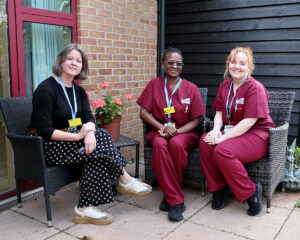
Palliative Care GP Fellowship Consultant Dr Claire Medhurst, Registered Nurse Ejaita Deinde and Registered Nurse Cleo Gibbons
She speaks openly about her experience with staff and patients, not to persuade anyone, but simply to show what donation can mean. It is a reminder that the people asking these questions understand, from all sides, just how much a donation can change a life.
Expanding this work across our community services
Most of Farleigh’s care takes place in the community, with patients at home supported by our community nurses and district nursing colleagues. The ambition now is to extend these conversations further, so that patients who choose to die at home have the same opportunity to donate as those who come into the Inpatient Unit.
“It would be lovely to know our community teams and district nursing colleagues are able to help honour the wishes of our patients out in the community.”
The potential impact of that extension is significant. The Inpatient Unit currently supports around two referrals per month, but the majority of Farleigh’s patients are cared for in the community. If community nurses and district nursing colleagues can introduce cornea donation as naturally as the Inpatient Unit team now does, the number of patients given the opportunity to donate could increase considerably. Even a modest increase in referrals could translate into dozens more donors each year, and potentially hundreds more people regaining their sight.
In November, Dr Medhurst will be presenting the team’s findings at the Hospice UK conference, an opportunity to share what Farleigh has learned with a national audience and encourage other hospices to start these conversations too.
Find out more about cornea donation
If you would like to learn more about corneal donation, or to have a conversation about your own wishes or those of someone you care for, please speak to a member of our team. We are always happy to talk it through.
You can also find information and register your wishes at NHS Blood and Transplant.